


By the time I turned 25, I was staring at a mountain of accumulated debt totaling $40,000 between credit cards and personal loans. It didn’t happen overnight; it was a slow slide that began with a single decision when I was just a teenager.
It started when I was 19 years old. I was already doing well professionally, working as a Continuous Improvement Manager, and I felt I deserved a reward. I wanted a car. At the time, I only had about $400 in savings, but the car I wanted cost $6,000. Instead of waiting, someone gave me the terrible advice to just take out a personal loan and pay it off monthly. I thought it was a great idea.
That was my first mistake. I got used to obtaining things immediately. I could have easily taken the bus or a taxi, but I wanted the luxury of a car right then and there. I refused to work for the savings; I chose the shortcut of debt because I prioritized status over patience.
The Snowball of Bad Decisions
Once I opened the door to borrowing, everything else followed. I tried to launch a few side businesses thinking they would be my ticket to wealth, but they unfortunately crashed and burned, leaving me with another $7,000 in losses. But looking back, the failed businesses weren’t the real problem; my lifestyle was.
Between the monthly car payments and the debt from my failed ventures, my paycheck was evaporating before I could even enjoy it. I didn’t have much cash left over to date or impress the girls I was seeing. I wanted to be the guy who could pick up the check at dinner, not the guy counting pennies. So, I applied for a credit card. I lied to myself, saying I would use it strictly to “get organized” and build credit.
For the first two or three months, I was disciplined. I paid the full balance every cycle to avoid interest. But after six months, I started slipping. I saw something I wanted, bought it, and told myself, “It’s okay to pay a little interest just this once. I’ll split the payment over two months.” That was the beginning of the end. Before I knew it, the card was completely maxed out.
Then came the breakdown—literally. My car needed expensive repairs, and I had absolutely zero cash. Feeling squeezed and desperate, I made the classic debt consolidation mistake. I went to the bank and took out a new personal loan of $6,000 to pay off the credit card. It seemed so smart on paper: the high-interest card balance went instantly to zero, and I felt a wave of relief.
But I failed to do the most important thing: I didn’t cancel the credit card. I left the account open with a zero balance. Psychologically, I felt like I had paid off the debt, but all I had done was move it. With the card empty again, I immediately started swiping it for dinners and clothes. Within months, I was in a worse position than before: I now had the $6,000 personal loan to pay back, plus a credit card that was maxed out all over again.
The Math That Didn’t Add Up
The problem escalated until I had an accumulated debt of $40,000 and couldn’t even afford the minimum payments. Looking back, my failure wasn’t just about the loans; it was about my mindset. I wanted things fast, with no effort to save, spending on luxuries to impress people who didn’t even care about me.
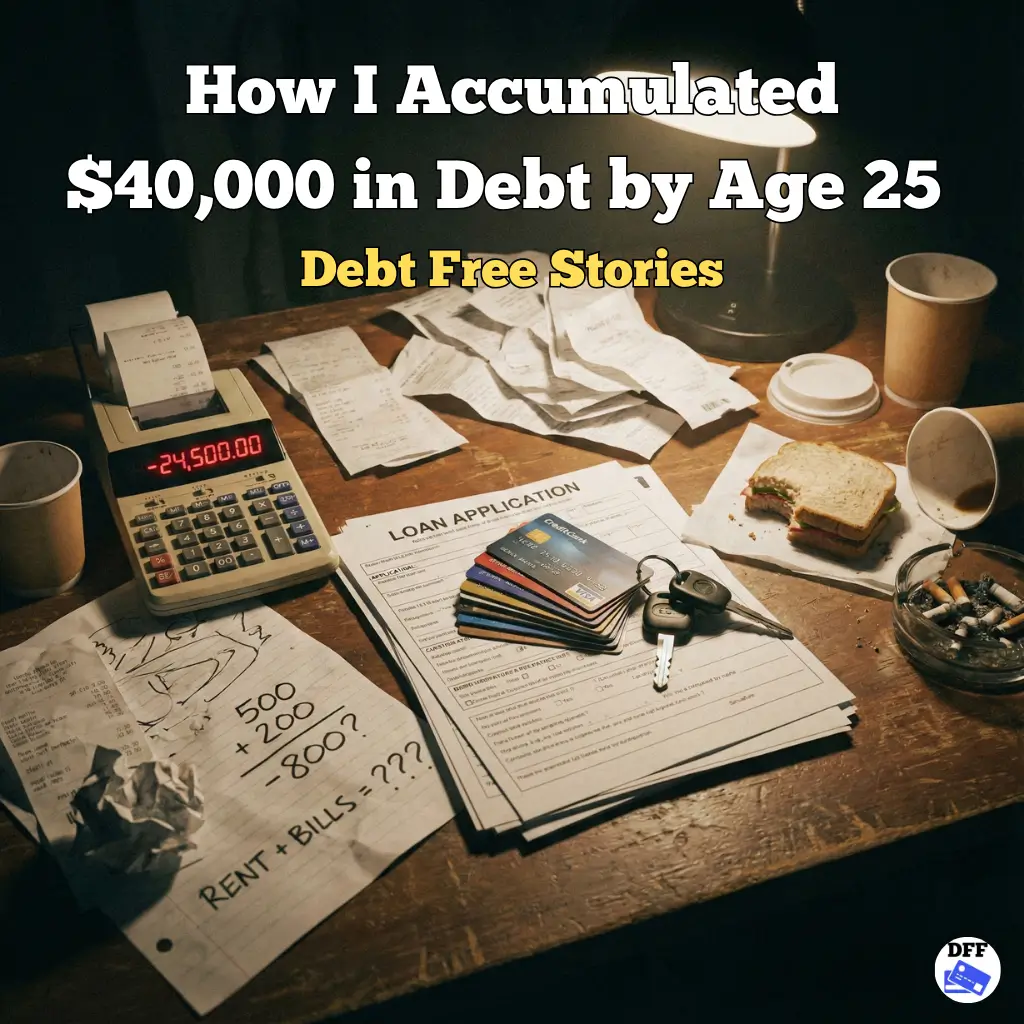
Worst of all, I had no financial plan. I didn’t have an Excel sheet or a budget. I did “mental math.” I would tell myself: “Okay, I earn $1,500. My debt payments are about $1,000. That leaves me with $500, which is plenty.”
I was lying to myself. I wasn’t accounting for university fees, clothes, car maintenance, or food. In my mind, those expenses were maybe $100. In reality, they were closer to $700. Every single month, I was running a $200 deficit. To cover the gap for food and basics, I had to borrow more money, digging the hole deeper every thirty days all because I lacked a structured financial plan.
If you found this story on How I Accumulated $40,000 in Debt by Age 25 helpful, we invite you to [Read our Guide on Zero-Based Budgeting] to stop the bleeding and create a real financial plan today.