

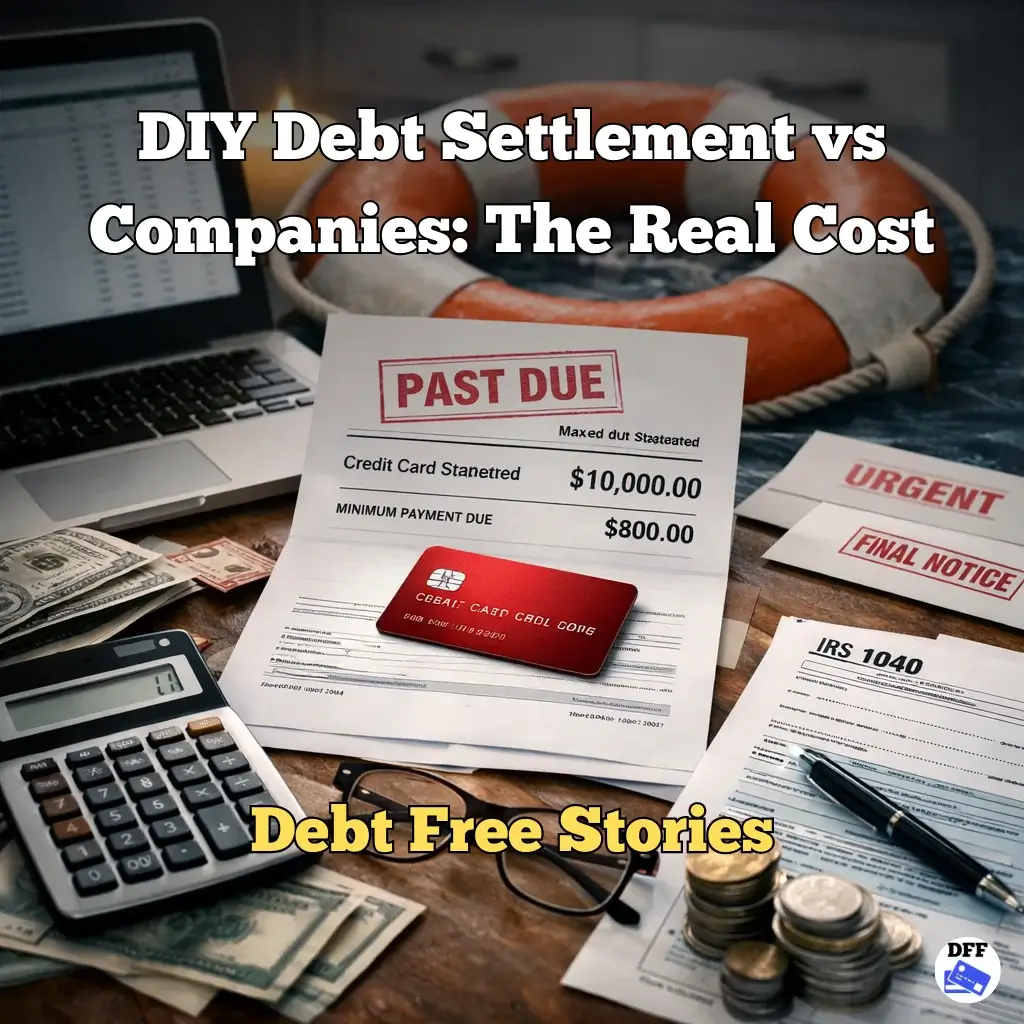

When I was drowning in $40,000 of consumer debt, the flashy ads for “Debt Relief” sounded like a lifeboat. I remember sitting at my kitchen table, staring at a maxed-out credit card statement, listening to a sales rep promise to cut my payments in half.
I almost signed the contract. But before I did, I decided to do something the sales rep didn’t expect: I opened a spreadsheet.
What I discovered wasn’t just a bad deal; it was a mathematical trap. I realized that between their front-loaded fees and the surprise tax bill from the IRS, I would barely save any money—while completely torching my credit score in the process.
Here is the breakdown of why I ghosted the debt settlement company and decided to negotiate my own debt (and how you can do it too).
The Data: Professional Settlement vs. DIY
The sales pitch usually claims they can settle your debt for 50%. What they don’t emphasize is their fee (usually 15-25% of the original debt) and the taxes you owe on forgiven debt.
I created this comparison based on a $10,000 credit card balance to see the real cost.
| Cost Breakdown | Hiring a Company | DIY Settlement (You) |
|---|---|---|
| Original Debt | $10,000 | $10,000 |
| Settlement Amount (50%) | $5,000 | $5,000 |
| Company Fee (25%) | $2,500 | $0 |
| Taxes (22% Bracket) | $1,100 | $1,100 |
| Total Cost to You | $8,600 | $6,100 |
| TOTAL SAVINGS | $1,400 (14%) | $3,900 (39%) 🏆 |
By doing it myself, I saved an extra $2,500 just on this hypothetical $10k balance. Scale that up to my actual $40k debt, and hiring a company would have cost me $10,000 in unnecessary fees.
The “Escrow Account” Trap
Beyond the math, there is a mechanical trap in how these companies operate.
When you sign up, they don’t pay your creditors immediately. Instead, they tell you to stop making payments to your credit cards and start paying them into a special escrow account.
They wait until your accounts go into default (usually 3-6 months) to gain leverage. While this happens:
- Your credit score drops by 100+ points.
- Late fees pile up, increasing the total balance.
- Creditors may sue you before the settlement company even makes an offer.
I had already experienced enough stress with my finances—as I wrote about in my story regarding [“The Payday Loan Trap“]—and I wasn’t willing to risk a lawsuit just to pay a middleman.
Step-by-Step: How to Settle Debt Yourself
I learned that creditors don’t have magical phone lines reserved for settlement companies. They will talk to you. Here is the exact protocol I used to handle my own negotiations.
1. Validate the Debt First Before offering a penny, I made sure they legally owned the debt. I sent a “Debt Validation Letter” via certified mail. In two instances, the collection agencies couldn’t produce the original contract, and the debt was dropped entirely.
2. Start Low (The Anchor Offer) Once validated, I called the collection department. I didn’t start at 50%. I started at 25%.
- My Script: “I am looking at bankruptcy options, but I would prefer to settle this today. I can borrow $2,500 from a family member to close this $10,000 account immediately. Take it or leave it.”
- They will say no. But it anchors the negotiation low. We usually met in the middle at 40-45%.
3. Get It In Writing This is non-negotiable. I never paid over the phone until I received a letter (or email) stating: “Acceptance of this payment constitutes payment in full and releases the debtor from all liability.” Without this letter, they can take your money and sell the remaining balance to another collector.
4. The “Pay for Delete” Unicorn For one of my smaller debts, I refused to pay unless they agreed to delete the negative trade line from my credit report. This is harder to get in 2026, but for smaller agencies, it still works. It helped me rebuild my score much faster than if I had a “Settled for less than full balance” remark.
Dealing with the IRS (The Insolvency Rule)
One massive detail debt companies gloss over is the 1099-C Form. If a creditor forgives $600 or more, the IRS counts that “savings” as taxable income.
However, I learned about the Insolvency Exclusion (Form 982). Since my total liabilities (debts) were higher than my total assets (car, savings, etc.) at the time of settlement, I didn’t have to pay taxes on that phantom income. Note: I am not a CPA, so please consult a tax pro, especially if you have complicated tax situations like the ones I mentioned in my post [“Side Hustle Tax Debt“].
Final Thoughts: Keep the Power
Hiring a debt settlement company is like hiring someone to go on a diet for you. They can’t do the hard work; you still suffer the credit damage and the stress calls. The only difference is they charge you the price of a used car for the privilege.
It took me a few weeks of uncomfortable phone calls to settle my accounts, but keeping that 25% fee in my pocket was the first step toward my actual freedom.
Read Next: Speaking of financial traps where the math works against you, debt settlement isn’t the only danger zone. I made a massive mistake trading in my vehicle because I didn’t understand how “Negative Equity” really works. Read: my $45k car loan nightmare here.