


My name is Sarah. I’m twenty-one years old, living in Chicago, and last year I was drowning in the stress of paying for my college tuition and rent. When you are working two part-time jobs and still barely have enough money to buy groceries, your judgment gets clouded. You start hoping for a miracle.
That’s how a moment of financial desperation led me straight into a sugar daddy scam, leaving me $4,500 in debt and on the verge of eviction.
The Fake Payment and The Bank Loophole
It started with a direct message on Instagram. An older man, whose profile was filled with pictures of luxury cars and expensive vacations, reached out to me. He was polite, strictly professional, and offered a straightforward arrangement: he wanted to be my online “sugar daddy.” He explicitly stated he didn’t want anything physical; he just wanted someone to talk to, and in exchange, he would pay me a weekly allowance of $1,000.
I was skeptical, but my bank account was overdrawn. I figured I had nothing to lose by just talking to him. After a few days of innocent texting, he told me he was ready to send my first allowance. This is where the trap was set. He sent me a digital image of a cashier’s check for $2,500. He told me to deposit it using my bank’s mobile app, keep my $1,000 allowance, and use the remaining $1,500 to do a “favor” for him.
I uploaded the image. The next morning, my banking app showed my balance had increased by $2,500. I thought it was a miracle. I felt completely safe.
People always ask me, “If the check was fake, how did your bank app show the money was in your account?” This is the exact loophole that makes the sugar daddy scam so dangerous, and I wish someone had explained it to me. By law, banks are required to make deposited funds available to you within one or two business days. It is a courtesy system designed so people don’t have to wait weeks to pay their bills. When I deposited his digital check, my bank credited my account immediately in good faith.
But here is the secret: “available” does not mean the check has “cleared.” It takes the banking system several days, and sometimes weeks, to physically verify the funds with the issuing bank and realize the check is completely fraudulent. The scammer knows this invisible clock is ticking. That is exactly why they pressure you to send money back to them immediately, before your bank discovers the fraud.
The Gift Card Trap and The Devastating Reality
Because I saw the $2,500 sitting in my app, I truly believed I was spending his money. His “favor” seemed strange but simple. He claimed he was having issues with his credit cards while traveling internationally and needed to pay a vendor. He asked me to take the extra $1,500 he had just sent me, go to the nearest pharmacy, and buy Google Play gift cards.
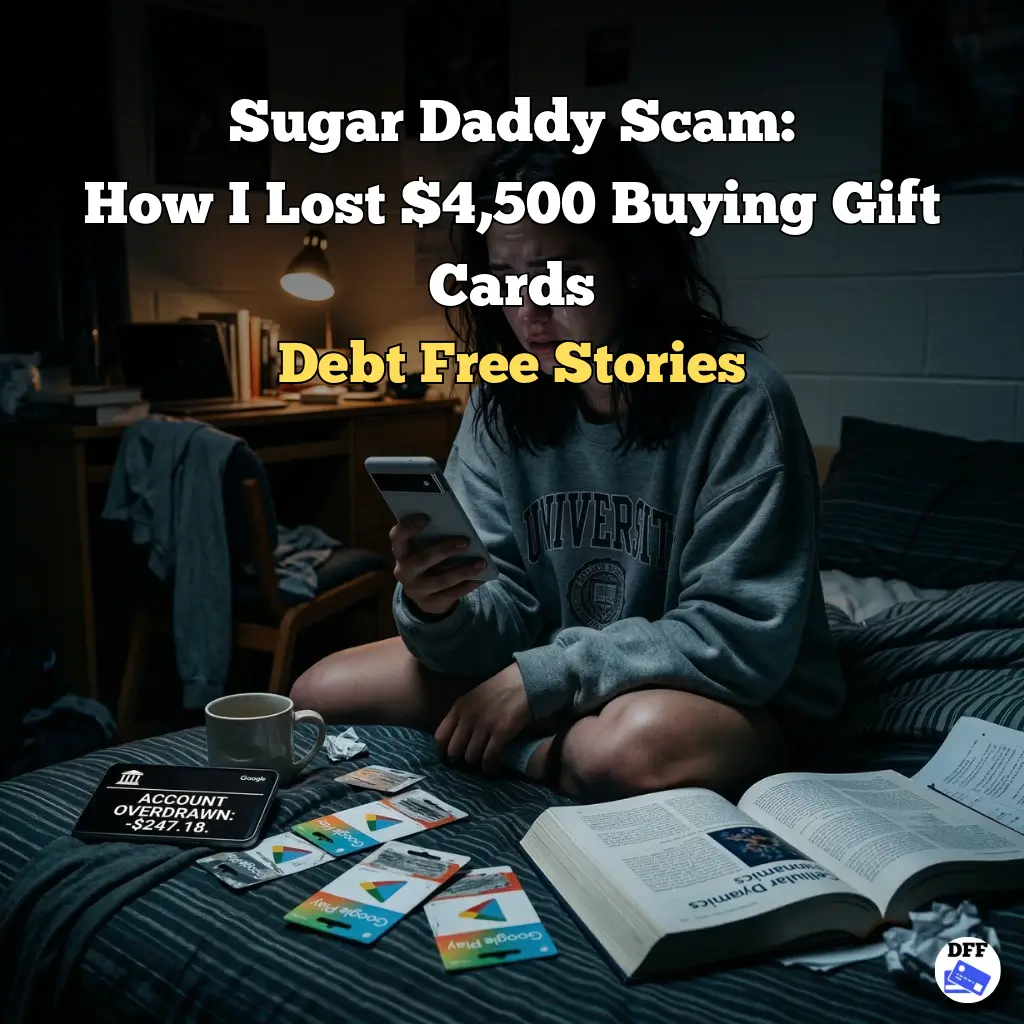
I bought the cards and texted him the redemption codes on the back. A few days later, he sent another check for $3,000 via a fake PayPal email, asking me to do the same thing. I bought another $3,000 in gift cards.
Three days later, the invisible clock ran out. I woke up to a terrifying notification from my bank. My account was frozen, and my balance was negative $4,500.
When the bank finally realized the checks were fake, they reversed the deposits. But the $4,500 I had spent on gift cards was my own real money, and it was gone forever. The “sugar daddy” had blocked me on every platform.
If someone offers you free money online, it is almost always a scam. Legitimate people do not ask you to process their money, pay their vendors, or buy gift cards for them. Don’t let financial desperation turn you into an unwitting money mule.
Scammers prey on our vulnerabilities, whether it’s financial desperation or the desire for connection. If this story sounds familiar, it’s a tactic used across many platforms. Read how another victim’s retirement was wiped out by online dating scams on Tinder to learn how to spot these manipulators before they drain your accounts.
Scammers prey on our vulnerabilities, whether it’s financial desperation or the desire for connection. If this story sounds familiar, it’s a tactic used across many platforms. Read how another victim’s retirement was wiped out by online dating scams on Tinder to learn how to spot these manipulators before they drain your accounts.