


It was a bright, sunny Tuesday during my freshman orientation week at college. The campus square was buzzing with energy. Clubs were recruiting, music was playing, and there were colorful tents everywhere.
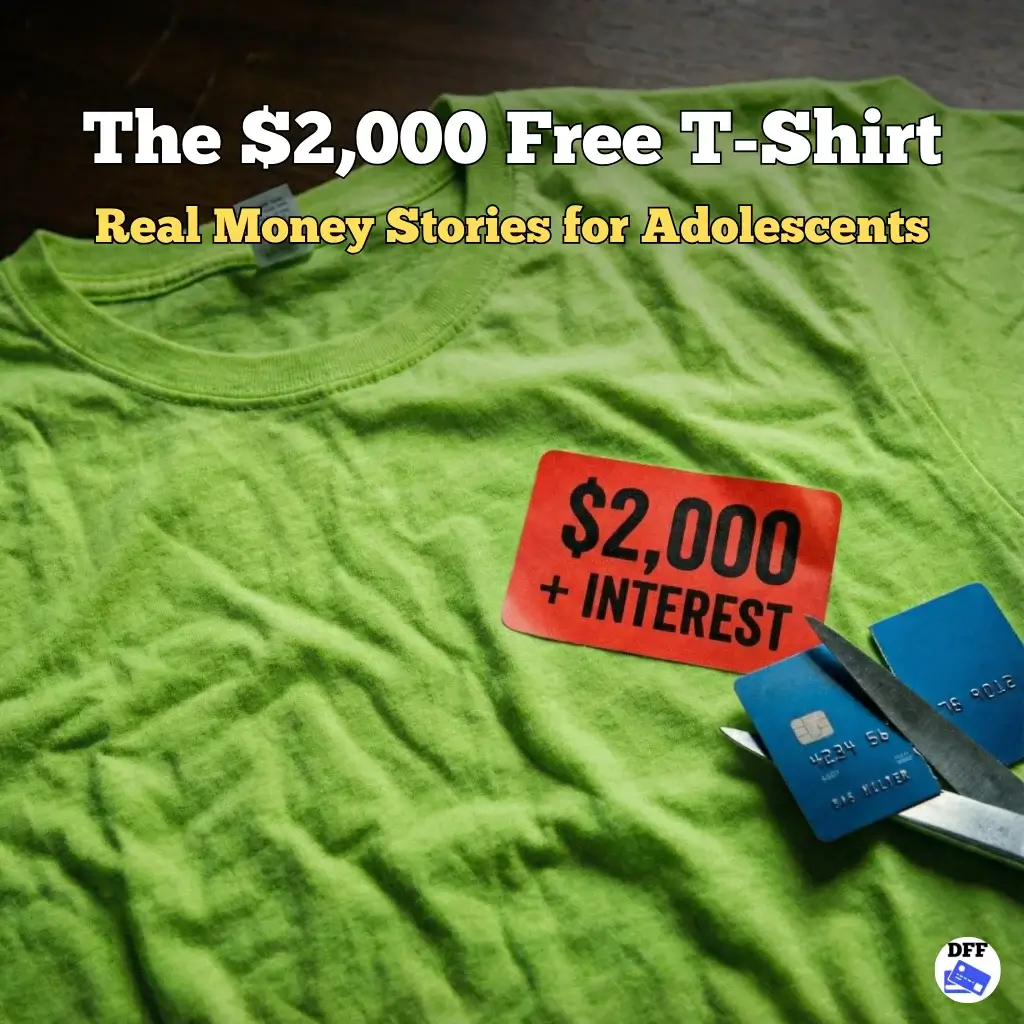
But one tent, in particular, caught my eye. It had a massive banner that read: “FREE T-SHIRT! SIGN UP TODAY!”
I was 18 years old. I had $50 in my bank account and a desperate need to fit in. I loved free stuff. I walked over.
If you are a parent or a teacher looking for real-life stories for adolescents about money, this is the one you need to share. Because that “free” t-shirt ended up costing me over $2,000.
The Bait and Switch
The guy at the booth was friendly. He smiled and handed me a clipboard. “Just fill this out,” he said. “It takes two minutes, and you get the shirt right now. Plus, you get a credit card for ’emergencies’. It builds your credit!”
He made it sound so responsible. “Building credit.” That sounded like something an adult does. I didn’t ask about the interest rate (it was 24.99%). I didn’t ask about the annual fee. I just wanted the neon green shirt with the cool logo.
I scribbled my name, social security number, and address. Five minutes later, I walked away wearing my new shirt, feeling like I had won.
A week later, the shiny plastic card arrived in the mail. My name was embossed on the front. It felt powerful. The limit was only $500, but to an 18-year-old earning minimum wage, $500 felt like a fortune.
I told myself I would only use it for emergencies.
But here is the trap in most financial stories for adolescents: Your definition of an “emergency” changes when you have easy access to credit.
Suddenly, an “emergency” wasn’t a flat tire.
- An “emergency” was ordering late-night pizza because the dining hall was closed.
- An “emergency” was buying a new outfit for a party because I had “nothing to wear.”
- An “emergency” was concert tickets because “everyone else is going.”
Within two months, I had maxed out the $500 limit.
The Math of Stupidity
When the first bill came, it said “Minimum Payment Due: $15.” I thought, “Wow! Only $15? I can afford that!”
I paid the $15 and ignored the remaining $485 balance. I didn’t understand how compound interest worked. I didn’t realize that the bank was charging me huge fees every month just for carrying that balance.
I kept spending. I got a second card (to pay off the first one, thinking I was smart). Then a third store card to get a 10% discount on jeans.
By the time I was 20, that initial desire for a free t-shirt had snowballed into $2,000 of consumer debt spread across three cards.
The Real Cost
That neon green t-shirt? It shrank in the wash after two weeks. I threw it away.
But the debt? That stuck around for three years.
Because I was only making minimum payments, the interest kept piling up. I was working extra shifts at the library not to buy fun things, but just to pay for pizzas I had eaten two years ago.
The stress was constant. I dreaded checking the mailbox. I stopped answering phone calls from unknown numbers because I was afraid it was a collection agency.
The Lesson for Teens
This is one of those cautionary stories for adolescents that schools rarely teach.
Marketing companies know exactly how the teenage brain works. They know you value instant gratification (the t-shirt, the discount, the pizza) over long-term consequences. They are betting against you. And usually, they win.
Here is the truth:
- There is no such thing as a free t-shirt.
- A 10% discount is not worth a 25% interest rate.
- Your credit score is your reputation; don’t sell it for a piece of cheap cotton.
If I could go back to that sunny Tuesday on campus, I would walk right past that booth. I would keep my personal information to myself, and I would buy my own t-shirt with cash. It would have been the cheapest shirt I ever bought.
I kept using credit cards as a crutch because I had no cash savings. The only way I finally broke the cycle was by building a safety net first. Here is why you need one: Why a Starter Emergency Fund Beats Paying Debt