


I remember the exact pattern of the tiles on the bathroom floor. They were beige, hexagon-shaped, and slightly cracked near the grout.
I know this because I spent forty-five minutes staring at them, sitting on the edge of the bathtub with the door locked, while my wife and daughter were eating dinner in the next room.
My phone was in my hand. My thumb was hovering over the “Deposit” button. Again.
I had just lost $2,000 on a basketball game. It was supposed to be a “lock.” A sure thing. The kind of bet that was going to fix the hole I’d dug the week before. But the point spread shifted in the last thirty seconds, and just like that, the money was gone.
I felt like I couldn’t breathe. The walls were closing in. I wasn’t just broke; I was broken.
If you are reading or listening to this right now, feeling that same crushing weight on your chest, I need you to know something: You are not alone, and this is not the end of your story.
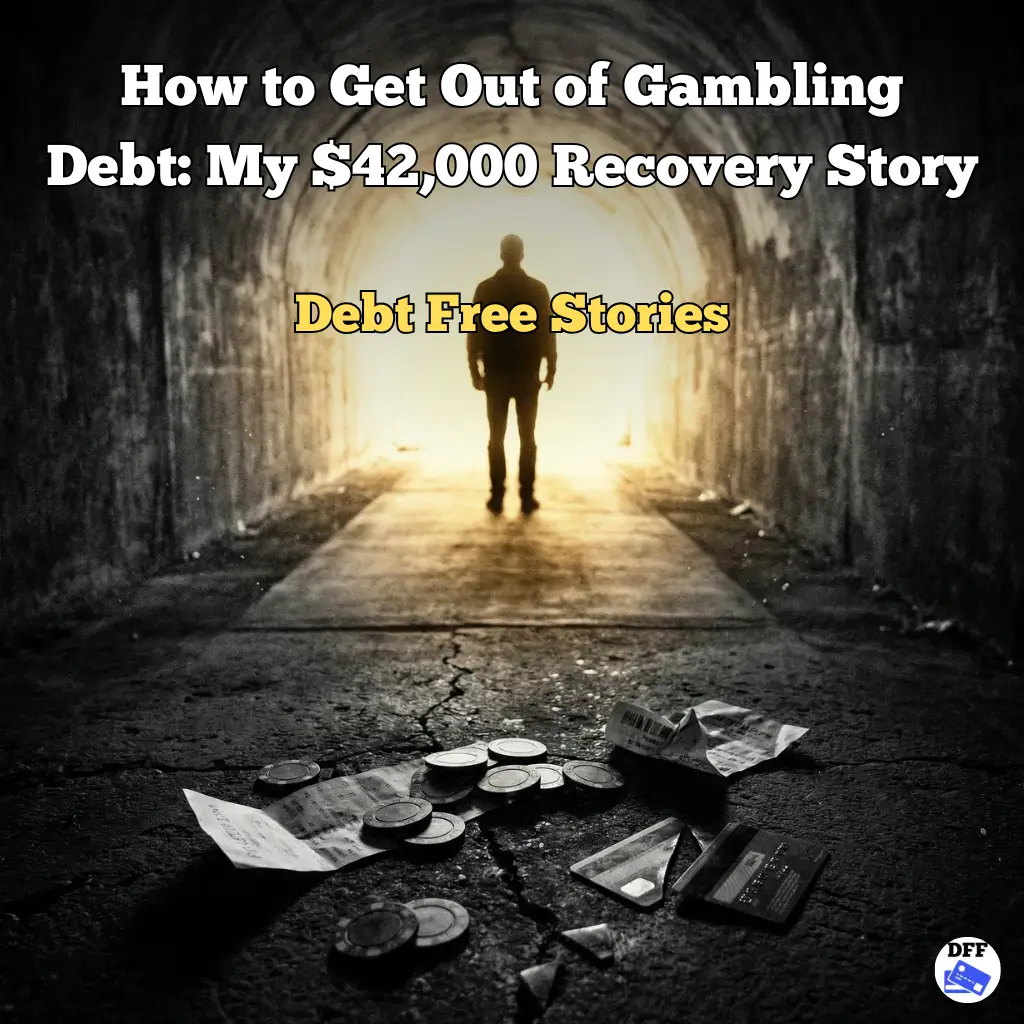
I racked up $42,000 in gambling debt. I lied to everyone I loved. I almost lost my marriage. But today, I am writing this with a positive net worth and a clean conscience.
Here is exactly how to get out of gambling debt, starting with the hardest part: the truth.
The Descent: How It Started
It didn’t start with thousands of dollars. It never does.
For me, it started with a “risk-free” $50 bet on a football game. I won. I made $45 in three hours while sitting on my couch. It felt like magic. My brain lit up. I thought, Why am I working 40 hours a week when I can do this?
That is the lie of gambling addiction. It convinces you that you are investing, not playing.
Over the next two years, the wagers got bigger. The losses got bigger. And the chase began. When you lose $500, you don’t stop. You bet $1,000 to win it back. When you lose that, you bet $2,000.
I maxed out three credit cards. I took out a personal loan under the guise of “home improvements.” I was juggling balance transfers like a circus act.
The worst part wasn’t the money. It was the secrecy. I became a master of hiding. I checked the mail before my wife got home to hide statements. I changed passwords. I was present physically, but mentally, I was always checking scores, always calculating odds, always panicking.
The Turning Point
Rock bottom has a funny way of finding you when you are trying your hardest to avoid it.
My turning point happened at a grocery store checkout. It was a Tuesday. I was buying milk, cereal, and coffee. The total was $42.18.
I swiped my debit card. Declined.
I swiped my main credit card. Declined.
I felt the blood drain from my face. The cashier, a kind teenager, looked at me with pity. “Maybe try the chip reader again?” she suggested.
I knew the chip reader wasn’t the problem. The problem was that I had emptied our checking account to cover a loss from the night before, promising myself I’d win it back before the grocery run. I didn’t win it back.
I walked out of that store without the groceries. I sat in my car and cried for twenty minutes. Then, I drove home, walked into the living room, and told my wife everything.
It was the hardest conversation of my life. There was yelling. There were tears. She felt betrayed, and she had every right to. But getting the secret out into the light was the first moment I had been able to breathe in two years.
The Method: How I Cleaned Up the Mess
Deciding to quit is one thing. Actually fixing the finances is another.
When you are looking for financial recovery, you can’t just “try harder.” You need a system. Here are the specific steps I took to pay off $42,000 in 24 months.
1. Close the Doors (Self-Exclusion)
This is non-negotiable. If you are a compulsive gambler, you cannot have access to the apps. Willpower is a muscle, and right now, yours is exhausted.
I installed blocking software on my phone and computer (Gamban is a popular one). I also registered with my state’s voluntary self-exclusion list, which legally banned me from entering casinos or using legal betting sites.
I had to make it physically impossible to place a bet. If you are looking for gambling addiction help, this is step one. You have to stop the bleeding.
2. Full Financial Transparency
I handed over all financial control to my wife.
This was humiliating but necessary. I gave her my cards. She changed the passwords to the online banking. I received a small weekly cash allowance for gas and lunch.
If you are single, find a trusted parent, sibling, or friend. You need someone else to have eyes on your money until you can trust yourself again.
3. The Debt Snowball Method
When I looked at the pile of debt, I wanted to vomit.
- MasterCard: $4,500
- Visa: $8,200
- Personal Loan: $15,000
- Line of Credit: $14,300
I used the Debt Snowball method. This is where you list your debts from smallest balance to largest balance, regardless of the interest rate.
Mathematically, paying the highest interest rate first makes more sense. But gambling addiction isn’t a math problem; it’s a behavior problem. I needed a win. I needed to see a debt disappear.
I attacked that $4,500 MasterCard with everything I had. Every spare dollar went there. When it hit $0, I felt a rush—a real rush, better than any parlay I ever hit. Then, I rolled those payments into the Visa.
4. The Side Hustle (Offense)
I couldn’t just cut expenses; I had to increase income. I had created a $42,000 hole, and I had to fill it.
I worked my 9-to-5 job, and then from 6:00 PM to 9:00 PM, I drove for a food delivery service. On weekends, I mowed lawns.
I treated debt repayment like a second job. Every time I made $50 delivering food, I thought, This is real money. This isn’t a wager. It helped me re-learn the value of a dollar, which is something you lose when you gamble.
5. Therapy and Community
I joined a local support group. Walking into a room of strangers and saying, “I’m a gambler,” took the power away from the shame.
If you don’t address the why—the anxiety, the boredom, the need for dopamine—you will eventually relapse. Stop gambling not just by blocking apps, but by healing your mind.
The Outcome: Life on the Other Side
It took two years of grinding. It was boring. It was hard. We didn’t go on vacation. We didn’t eat out.
But let me tell you about the day I made the final transfer to the personal loan.
I clicked “Submit Payment.” The balance turned to $0.00.
I didn’t hear slot machine bells. I didn’t see confetti. I just heard the quiet hum of the refrigerator.
For the first time in years, I felt peace.
My marriage survived, though it took a long time to rebuild the trust. I am a better father because I am actually present now, not checking scores under the dinner table.
If you are in the thick of it right now, please listen to me: The shame is lying to you. It tells you that you are stuck. You aren’t.
You can fix this. You can ban the apps. You can tell the truth. You can work the plan.
Forgive yourself for the money you lost. It’s gone. It’s the tuition you paid for the life lesson you’re learning now.
Start today. Not tomorrow. Today.
“Gambling isn’t the only financial trap that can feel suffocating. Sometimes, we make decisions thinking they are ‘smart investments,’ only to find ourselves trapped in a different way. Read this honest confession on why I regret buying a house while poor


[…] to me with this business, and it happened when I tried to beat the casino. Read my confession on how to get out of gambling debt to see the […]
[…] you, you need to understand that gambling takes many forms. Read our other powerful confession on how to get out of gambling debt to see the exact $42,000 recovery story and find […]