

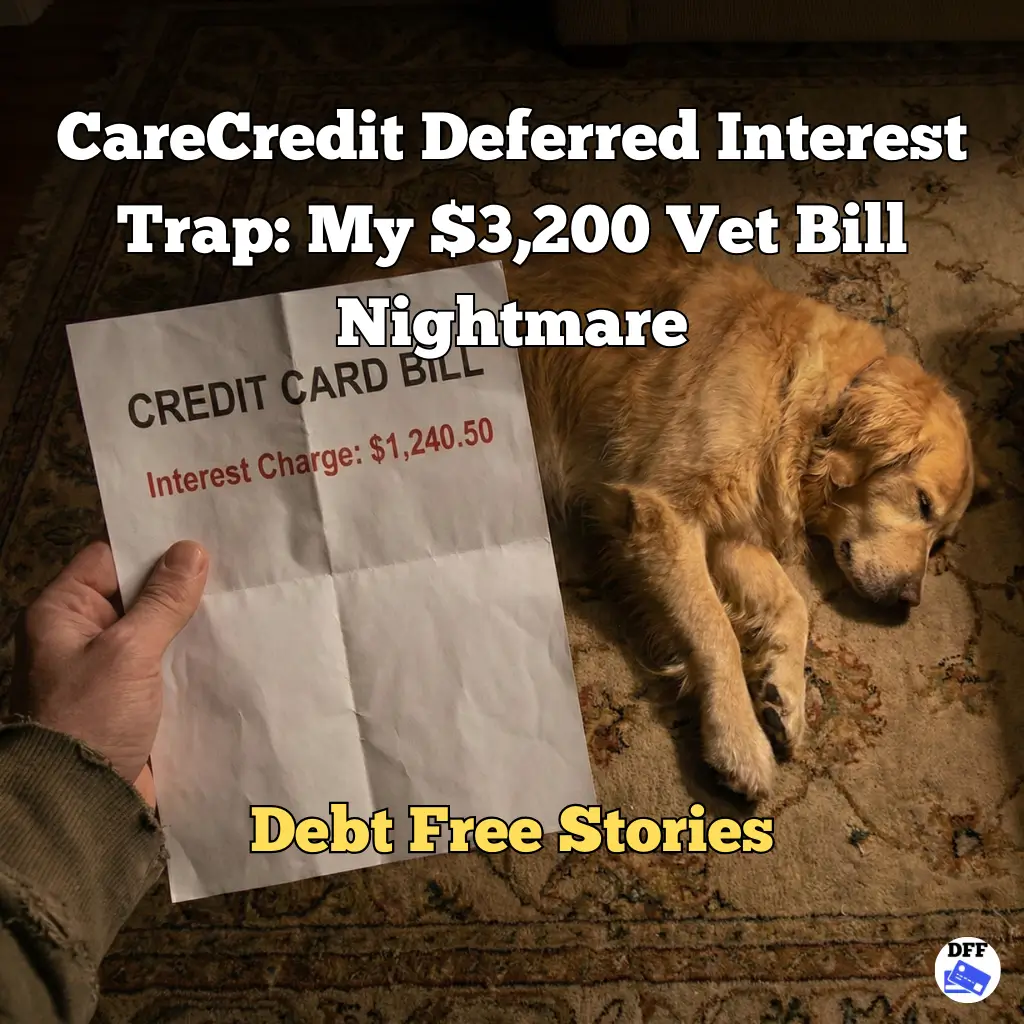

It was 2:30 AM on a Sunday. My Golden Retriever, Max, was dry heaving on the living room rug. I knew something was wrong—terribly wrong.
We rushed to the emergency vet, tears streaming down my face. After an X-ray, the vet gave us the news: Max had swallowed a sock. He needed immediate surgery to remove the blockage.
Then came the second blow: The estimate was $3,200. And they needed payment upfront.
I didn’t have $3,200. I had panic.
The receptionist, seeing my desperate face, slid a brochure across the counter. “You can apply for this medical credit card,” she said gently. “It has 0% interest for 12 months. You can pay it off slowly.”
I signed the papers without reading the fine print. I saved Max. He is sleeping at my feet as I write this. But while I saved my dog, I unknowingly signed up for a financial trap that would haunt me a year later: the CareCredit deferred interest nightmare.
The “Minimum Payment” Trap
For the next 11 months, I felt responsible. I felt like an adult.
The bank sent me a statement every month asking for a minimum payment of roughly $90. And every month, I paid it. Sometimes I even paid $100 just to be safe.
I watched the balance go down slowly. I thought I was winning. I thought, “I have 12 months of 0% interest, I’m fine.”
Here is the math error that ruined me: I assumed that the “Minimum Payment” calculated by the bank was designed to pay off the debt within the 12-month promotional period. It is not.
The minimum payment is usually just 3% of the balance. It is designed mathematically to leave you with a balance at the end of the promo period.
The Day the Bomb Exploded
Month 13 arrived. I still had about $800 left to pay on the surgery bill. I figured I would just pay interest on that remaining $800. No big deal, right?
I opened my app and gasped. My balance hadn’t gone down. It had jumped up by nearly $900.
I called customer service, furious. “There must be a mistake! I’ve been paying every month!”
The agent was calm and cold. “Sir, you accepted a deferred interest promotion. Since you didn’t pay off the entire balance by the expiration date, we have now charged you all the interest dating back to Day 1.”
What “Deferred Interest” Actually Means
This is the lesson that cost me $900. There is a massive difference between “0% APR” and “Deferred Interest.”
- 0% APR (True 0%): If you don’t finish paying in time, you only start paying interest on what is left.
- Deferred Interest (The Trap): The bank tracks the interest in the background every single month. If you leave even $1.00 of debt after the promo period ends, they take all that “hidden” interest and dump it onto your account at once.
They charged me 26.99% interest on the full $3,200 surgery from a year ago, even though I had already paid off most of it.
How I Fixed It (And The Rule I Follow Now)
I was angry, but anger doesn’t lower your credit utilization. I had to act fast because now I was being charged nearly 27% interest on a balance that was bigger than before.
Here is the exact strategy I used to stop the bleeding:
1. The “Escape Hatch” Transfer
I couldn’t afford to pay the CareCredit balance in full immediately. So, I opened a regular credit card that offered a “0% Balance Transfer” for 15 months (with a 3% fee). I moved the debt there. This stopped the interest clock instantly and gave me room to breathe.
2. The “Promo Period Minus One” Rule
I promised myself I would never trust a bank’s “minimum payment” again.
Now, whenever I use a “Same as Cash” or deferred interest offer for an emergency, I ignore the bill they send me. I do my own math using this formula:
(Total Debt) ÷ (Promo Months – 1) = My Real Monthly Payment
If the surgery was $3,200 and the promo is 12 months, I calculate: $3,200 ÷ 11 = $290.
- Why minus one? Because you never want to cut it close. If a payment takes a few days to process at the very end, you get hit with the back interest. I aim to finish one month early, guaranteed.
The bank asked me for $90. I should have been paying $290. That was the gap where I fell in.
3. I Built a Real Emergency Fund
The root cause wasn’t the surgery; it was that I had zero cash for emergencies. I realized that relying on debt for emergencies is just a delayed disaster.
I started small. I stopped focusing on paying down my mortgage or investing and focused 100% of my energy on saving my first $1,000 in cash.
Do you have an emergency fund for your pets? If you are relying on credit cards for vet bills, you are playing with fire. Start building your cash cushion today so you never have to sign a predatory contract at 2 AM.